Outliers, Malcolm Gladwell
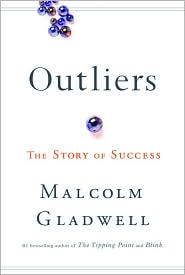
I was first made aware of this title by Pianist's French teacher (he was in 7th grade at the time) in an email. She wanted him to read it. Unfulfilled expectations and all that. This review isn't about him, though. So the day I read the email I put myself on the library waiting list for this book. I was number forty seven. Bummer. It took five months before it was our turn. In the meantime, I watched Charlie Rose's interview with Mr. Gladwell.
In America, the mythos of the self made man is a deeply entrenched, beloved belief that is in some ways central to our culture. Generally, we're supposed to believe that here in the US anyone, from anywhere, from any background can rise to the top of our society through their own hard work & very little else. Like cream rises from milk. Unbidden & naturally. We like to pretend such things are practically guaranteed by the constitution, for heavens' sake! Or so the thought goes.
IMO, it's quite easy to sum up Outliers: it's a thoughtfully written, soundly defended debunking of the myth of the self made man. Mr. Gladwell's position is that preferential treatment can be based on such arbitrary measures as birth dates, generational size and parenting style. He argues that coincidental circumstances and arbitrary random sorting of children often boosts one group over another. Success, according to this position, results from cumulative advantages & isn't merely the result of native ability.
Mr. Gladwell reveals that parenting styles may differ by economic class- and that these seemingly inconsequential differences can ultimately have a serious impact on how much better one child may do as opposed to another. In other words, socialization training taught in the home can have more impact for better or for worse on a child's trajectory than many parents may be willing to admit.In young children an age difference as little as four or six months can make a huge difference in academic and athletic outcomes. He uses the Canadian hockey training system and American kindergartners as effective examples. In other words, future achievement is predicted better by family involvement, location, culture and cumulative advantages that started early in life- not necessarily intelligence quotient, work ethic and other nebulous characteristics.
Mr. Gladwell discusses such vagaries as how Asian language structures inherently confer advantages on their young learners that English does not- giving their children a strong and enduring boost up the ladder that lasts through their childhood into their adulthood. Gladwell shows how it may take a few generations for a family or group to boost itself out of one economic class into another and he tells us how much effort that entails & what the rewards and sacrifices may be.
Outliers isn't a book I'd've necessarily picked up on my own and for that I'm grateful to the French teacher. Anyone who is interested in the sociological origins of success and how various factors impact each individual should pick this up. It's a fascinating read.


