Showing posts with label World War II fiction. Show all posts

Saturday, January 17, 2009

The Guernsey Literary and Potato Peel Pie Society
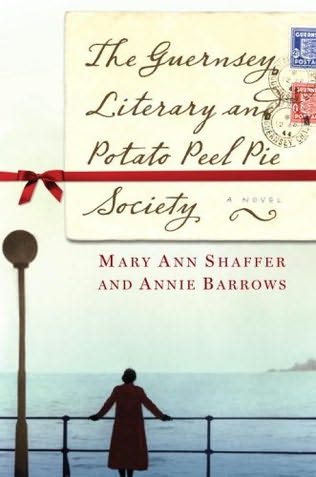

Authored by Mary Anne Shaffer and Annie Barrows, The Guernsey Literary and Potato Peel Pie Society, was published in hardcover by Dial Press in July 2008. Click link in title above to go to publisher's reader's guide. I picked it up on the dual basis of online word of mouth blurbs and the fact that the book was placed facing the front door of the library branch I regularly frequent. It’s in a similar vein to the book Five Quarters of the Orange which I read and reviewed last summer. Both books deal with the impact of World War II on small Nazi occupied villages in France and Guernsey respectively. TGLAPPS is written in epistolary form.

Set in the England of 1946, Miss Juliet Ashton, aka columnist ‘Izzy Bickerstaff’, is sent out on a book signing tour in support of her latest book. Her publishers, also dear friends of hers, have asked her to think up a new project and write a book. Juliet, however, has the proverbial writer’s block. Her Izzy Bickerstaff columns were light and witty and observant, but England’s ongoing financial struggles and related woes have put Juliet off of anything in a similar vein. Unfortunately, she has no idea what to write.

One day she receives a letter from a man on Guernsey. It seems he has come across a book that had her name and address in London in it. He has written to her in hopes that Juliet will send him the name of a good bookshop that might mail books out to Guernsey. Thus begins a correspondence between Literary Society members and Juliet. The reader experiences, through the letter writers’ eyes, what life on Guernsey was like during the war just ended the previous year. All of the trials and tribulations and strife and small joys and victories. I almost felt like a voyeur, peeping in the windows of a tightly knit and loving community doing everything they could to survive.

The Literary Society was born fully formed out of the mind of one of the members when several islanders were caught out after curfew. After which episode, the villagers had to meet regularly to ‘make the Society real’. Unfortunately they were stuck with whatever books were ready to hand as, obviously, no new books would be shipped out to Guernsey from either France or England. Titles mentioned or briefly discussed are: The Meditations of Marcus Aurelius, Selected Essays of Elia, Wuthering Heights, Pickwick Papers, Selections from Shakespeare, Catullus, Oxford Book of Modern Verse 1892-1935, Letters of Seneca, Past & Present, Pride & Prejudice and Canterbury Tales.

Like Chris Bohjalian’s newest book Skeletons at the Feast, TGLAPPS recounts how one person becomes the glue that holds a little community together, a person whose resourcefulness and integrity becomes the focus of daily survival. Readers watch as Juliet and the Society members heal. The power of books to temporarily allow their readers to escape reality and to expand horizons and broaden viewpoints is widely discussed via the letters and in person conversations.

Excellent book. Very eye opening for me as a) I’m too young to remember WW II and the attendant privations and b) I’m not British, so this viewpoint was helpful and unique.

Note to myself- read in 2008, do not include in 2009 statistics.

Saturday, November 29, 2008

Skeletons at the Feast; Chris Bohjalian


Image found on Random House

Published by Random House this year, Skeletons at the Feast is the first novel by Chris Bohjalian that I've read. This is a fictionalized account of the Nemmersdorf massacre of October 1944, among other events. Primarily this is an account of how the Emmerich family, either German or Polish depending on which year you ask them, views the war and attendant atrocities perpetuated on both military members and the civilian population. Skeletons at the Feast is also the story of a group of slave laborers. Mr. Bohjalian tries to illuminate the outer limits of humanity. Just how thick is the veneer of civilization, anyway?

Mr. Bohjalian raises numerous questions in the reader's mind- and leaves you to mull over what your choices would be if you were in similar situations. It's very easy to sit in the midst of our comfortable lives and pass judgement on what you'd do if you were them. Or what the "right" choice/option/behavior should be. But when the rubber hits the road, where real life intersects idealization, no one really knows. Would you be willing to be one of the few in your community to speak out, to be honest about your thoughts and feelings, if you knew your children would be the ones to suffer for your honesty and outspokenness? If you depend on the government for your livelihood but you disagree with their actions, would you follow your conscience even if the possibility you'd lose your livelihood or be imprisoned or worse? This is not to mention the effects of what I would call "hive mentality" or mindless conformity has on those persons who don't or can't fit the desired mold.

The Emmerich family, no matter which way the boundaries are drawn, consider themselves loyal Germans. They own and run a large and prosperous farm near the Vistula River. Both the father, Rolf, and the older son, Werner, serve in the army in various capacities. Mother Irmgard, twins Anna and Helmut and little Theo have to run the farm with only one 'farmhand'- aka a Scottish POW laborer named Callum Finella. The awful, evil, uncivilized Soviets are advancing & eventually it's obvious everyone needs to flee ahead of Ivan. Rolf and Helmut stay behind at the village near the farm to try and defend it. Irmgard, Anna and Callum flee West toward the Allies. Callum, they hope, will be their insurance policy to get them across the lines. There's also the relationship developing between Anna and Callum. Along the way they hook up with a resourceful guy named Manfred. Manfred reminded me of a darker, more rounded version of Radar or Klinger on the tv show MASH: a person who is able to come up with whatever anyone needs to survive their shared ordeal. He hooks up with Calum and the Emmerichs, and together the little party begins the arduous trek West. Meanwhile, we also follow a group of slave laborers from many nations, but two from France in particular: Cecile and Jeanne. Bohjalian does not dig deeply into the gruesome events related to their captivity. Rather he explores small events and interactions between the inmates that reveal each woman's capicity to rise or sink like bubbles in the breeze.

I found Skeletons at the Feast to be profoundly thought provoking. It reminds the reader that we often hold unexamined assumptions and beliefs about people and historical events. Stress and danger and life threatening situations bring out both the best and the worst behavior in people. It's impossible to predict which person will react in which way. I thought Calum and Anna's story reminds readers that there is often an elemental desire to connect with another person on a deep level, a need to express hope and joy and faith in each other even in the face of our darkest hours. I really enjoyed this example of Mr. Bohjalian's work, and I plan to borrow more from the library.

Sunday, August 24, 2008

Five Quarters of the Orange; Joanne Harris


I’ve had this book for years, I probably bought it new, but it sat and sat. Until one day I finally pulled it down and read the first few pages and *wham!* I was hooked. Just like that. Often a book will have to wait patiently, very patiently, after it comes to live on my shelves until I pull it out to read it. As the song says, I have to be in the mood again. Otherwise, either I won’t finish it or it’ll be a wallbanger or I’ll pick it apart. Or I’ll trade it or give it as a gift without actually reading it. But- if I’m in the mood? At least it’ll have a fair shake, so to speak.

Anyhow, Ms. Harris has written quite a few other books, Chocolat perhaps most notably. While reading Five Quarters I was reminded somehow of Like Water for Chocolate, written by Laura Esquivel. In different ways each author emphasizes centrality of food and family, the lasting effects one event can have. Both novels are powerful. Ms. Harris’ character does not triumph until much later in her life, but I ought to save that for later, I suppose.

Five Quarters is narrated by a sixty something year old woman named Boise, Framboise properly. That was one of Ms. Harris’ unique touches, most of the narrator’s family members are named (in French) after foods. The one sibling who isn’t? Comes to a tragic end. I am getting ahead of myself though. The narrative moves back and forth between Boise’s present and one year, during World War II, that is the pivot of all their lives. Framboise, her sister and their brother live with their widowed mother on a little farm in rural France. Money is tight; they do whatever they can to make ends meet. Right from the start their mother is harsh, cold, rarely allowing finer feelings to surface. Then again, if I had no money, three kids and a farm to run I don’t know that I’d be able to show softer feelings either, TBH. Still, their mother is hard on them and appears to have more than a small touch of what is now called obsessive compulsive disorder.

In the present day Framboise has returned under cover to the farm, using her married surname only. She is a secretive woman. Like her mother, she shows few of her feelings: coldness, irritation, anger. You realize that she would be a difficult woman to live with, a difficult woman to love. Prickly and defensive, Boise is a woman who is more likely to wound you first to save herself from you wounding her. The best defense is a good offense. The question is: what happened to make her this way? What happened to the little family that Framboise has snuck back to the farm incognito decades later? Why after all of these years is she still hiding?

I talked out loud to myself while I read this- not a common occurrence for me. “O.M.G.” “You’re kidding!” “Wow. That explains a lot!” And, last but not least, “Boy, I didn’t see that one coming!” Because Boise was a kid during the flashbacks, you only have as much information as a kid could expect to have or reasonably expect a kid to figure out. And Boise, while smart and tough and resourceful, is still only a kid.

Five Quarters of the Orange is a wrenching, powerful read. Ultimately, it’s about personal growth and love and making peace with the past. A wonderful, wonderful book. Keeper.

Image found on Harper Collins