Showing posts with label literary fiction. Show all posts

Saturday, January 17, 2009

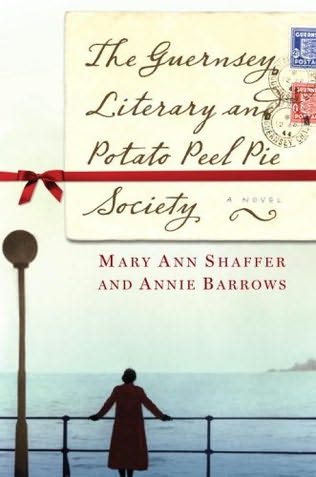
The Guernsey Literary and Potato Peel Pie Society


Authored by Mary Anne Shaffer and Annie Barrows, The Guernsey Literary and Potato Peel Pie Society, was published in hardcover by Dial Press in July 2008. Click link in title above to go to publisher's reader's guide. I picked it up on the dual basis of online word of mouth blurbs and the fact that the book was placed facing the front door of the library branch I regularly frequent. It’s in a similar vein to the book Five Quarters of the Orange which I read and reviewed last summer. Both books deal with the impact of World War II on small Nazi occupied villages in France and Guernsey respectively. TGLAPPS is written in epistolary form.

Set in the England of 1946, Miss Juliet Ashton, aka columnist ‘Izzy Bickerstaff’, is sent out on a book signing tour in support of her latest book. Her publishers, also dear friends of hers, have asked her to think up a new project and write a book. Juliet, however, has the proverbial writer’s block. Her Izzy Bickerstaff columns were light and witty and observant, but England’s ongoing financial struggles and related woes have put Juliet off of anything in a similar vein. Unfortunately, she has no idea what to write.

One day she receives a letter from a man on Guernsey. It seems he has come across a book that had her name and address in London in it. He has written to her in hopes that Juliet will send him the name of a good bookshop that might mail books out to Guernsey. Thus begins a correspondence between Literary Society members and Juliet. The reader experiences, through the letter writers’ eyes, what life on Guernsey was like during the war just ended the previous year. All of the trials and tribulations and strife and small joys and victories. I almost felt like a voyeur, peeping in the windows of a tightly knit and loving community doing everything they could to survive.

The Literary Society was born fully formed out of the mind of one of the members when several islanders were caught out after curfew. After which episode, the villagers had to meet regularly to ‘make the Society real’. Unfortunately they were stuck with whatever books were ready to hand as, obviously, no new books would be shipped out to Guernsey from either France or England. Titles mentioned or briefly discussed are: The Meditations of Marcus Aurelius, Selected Essays of Elia, Wuthering Heights, Pickwick Papers, Selections from Shakespeare, Catullus, Oxford Book of Modern Verse 1892-1935, Letters of Seneca, Past & Present, Pride & Prejudice and Canterbury Tales.

Like Chris Bohjalian’s newest book Skeletons at the Feast, TGLAPPS recounts how one person becomes the glue that holds a little community together, a person whose resourcefulness and integrity becomes the focus of daily survival. Readers watch as Juliet and the Society members heal. The power of books to temporarily allow their readers to escape reality and to expand horizons and broaden viewpoints is widely discussed via the letters and in person conversations.

Excellent book. Very eye opening for me as a) I’m too young to remember WW II and the attendant privations and b) I’m not British, so this viewpoint was helpful and unique.

Note to myself- read in 2008, do not include in 2009 statistics.
Saturday, October 18, 2008

The Vanishing Act of Esme Lennox; Maggie O'Farrell


I found this on the ‘fortunate finds’ new release shelves in my local library back in late summer, although it was published back in 2006 by Harcourt. Ms. O’Farrell is a UK born writer whose other novels have received critical acclaim. Click the link in the title above to go to her website for more details. I was initially attracted by the cover, although the text on the flap intrigued me too. I was reminded, improbably enough, of one of Holly Black’s faerie novels in which an elderly woman has been institutionalized due to perceived instability. Prior to reading Ms. O’FarrelI’s novel this was distant intellectual knowledge as opposed to emotional realization of the potential exploitation of women by the men in their lives.

The plot opens with middle aged Iris Lockheart trying to deal with the news that she has an elderly relative in a mental institution, said institution is closing and the powers that be need Iris’ input into what will happen to Esme Lennox, Iris’ great aunt. It turns out that Esme is Kitty Lennox’s sister, whose very existence Iris’ mother Kitty denied. Kitty claimed to be an only child and of course Iris believed her. Iris becomes attached to Esme and when difficulties arise in getting a bed in another care home, Iris takes Esme to her home for the weekend. The story is superficially easy and the reader is lured into thinking TVAoEL will follow conventional lines. We would be wrong.

TVAoEL is a meditation on revenge (to exact atonement/amends or punishment for a wrong or injuries; Random House College Dictionary, 1st edition) versus vengeance (infliction of injury, harm, humiliation, etc. on a person by another who has been harmed by him; Random House College Dictionary, 1st edition). Ms. O’Farrell brings up questions of justice and mercy, revenge and vengeance, truth and lies in the context of the most intimate family relationships. We learn about men’s incredible legal power over women which effectively infantilized us in the eyes of the law. This power was sanctioned by the state, ie: men in power, and by society at large. Ms. O’Farrell draws us a picture, an emotional portrait, if you will, of the long term consequences this has on one family. Regrets come too late and are too few.

This is easily one of the most powerful and mesmerizing books I’ve ever come across. I read it twice and it was a page turner each time. Likely it is a book I will buy for my home library and will reread for years to come. Very highly recommended.

Image found on Harcourt Books

Wednesday, September 17, 2008

The People of the Book; Geraldine Brooks


Image found on Warren County (IL) Public Library

Published by Viking this year, The People of the Book was written by Geraldine Brooks who recently won the Pulitzer for her previous book March. I’ve not read March mainly due to uncertainty about if I’d be able to set aside my feelings and opinions about the book his character comes from, ie: he’s the dad in Louisa May Alcott’s Little Women. After I finished this one, though, I think I may borrow March and see just what Ms. Brooks has done with him. I am very very pleased I picked up TPotB. It’s an engrossing story about obsession and deception and preserving history and family expectations. About lies and truth and motivation.

The plot seems pretty basic on the face of it: a rare five hundred year old manuscript, an illustrated haggadah (the liturgy of the Seder) has turned up in Sarajevo. The United Nations and the local governments have asked a well known, if young, restorationist to come in and make assessments and, possibly, repairs. Interwoven with the contemporary story are vingnettes of the book’s past. The circumstances under which it was made. Who the artist was who painted the illuminations, and why she did them. How it was hidden the first time. The reader watches over Hanna Heath’s shoulders as she painstakingly, lovingly examines the manuscript, makes notes and discusses her findings with her mentors.

The haggadah’s travels range across the Old World from Spain to Vienna to Sarajevo, just as Hanna’s own life has straggled across Australia, the States and Europe in pursuit of knowledge, in pursuit of physical and metaphorical space between her mother and herself. I loved the vignettes of the haggadah’s creation. All of the different characters who play a role in its creation or preservation illuminate the time and place and condition of the people who possess it. The haggadah traces a small slice of European Jews and their tenuous integration in Christian Europe across history. Like many old and valuable objects, the haggadah has always been at the mercy of political ambition, greed power and persons who feel they have moral superiority over others.

Hanna too is at the mercy of these same forces, and it isn’t pretty. Hanna had me puzzled towards the end. Commonly, people’s identity is closely wrapped with their career. Hanna’s no different. She discovers something about the haggadah that literally causes her to question herself, her training, her very identity. Hanna is so shaken by events she leaves her profession. None of her mother’s forceful character and will seems to have transmitted itself to her. Hanna is unable to overcome childhood feelings of neglect and overshadowing to see her mother’s strength. This too is a common problem, nonetheless I wished very hard that Hanna could grow more.

My problem with how Ms. Brooks deals with this is that Hanna is too accepting, too emotionally needy of a companion thus she doesn’t deeply question people intimately involved in the events that led directly to her change of occupation. And I wanted her to. I was shocked that a woman whose life was so profoundly changed by people and events didn’t question them or rail at them when she had a chance. I felt let down in a way. I had come to really like Hanna quite a bit and I hoped for..more inquisitiveness, more questioning of people important to her and to the book. Even if they didn’t/wouldn’t/couldn’t answer her I would have felt better. Essentially Hanna is an historical investigator, but when it comes to real live people her investigating instincts and training are washed away. I don’t need all of the threads to be wrapped up in a neat bow, I simply feel that Ms. Brooks could have fleshed her out more after such a serious and life altering event.

The People of the Book is loosely based on real events surrounding a haggadah found in Sarajevo during the Bosnian war. I found the narrative enjoyable and engrossing if somewhat flawed. Link to brief article about the actual Sarajevo Haggadah. In depth article of actual relic and its recent history here, free registration necessary to read full contents.

Sunday, August 24, 2008

Five Quarters of the Orange; Joanne Harris


I’ve had this book for years, I probably bought it new, but it sat and sat. Until one day I finally pulled it down and read the first few pages and *wham!* I was hooked. Just like that. Often a book will have to wait patiently, very patiently, after it comes to live on my shelves until I pull it out to read it. As the song says, I have to be in the mood again. Otherwise, either I won’t finish it or it’ll be a wallbanger or I’ll pick it apart. Or I’ll trade it or give it as a gift without actually reading it. But- if I’m in the mood? At least it’ll have a fair shake, so to speak.

Anyhow, Ms. Harris has written quite a few other books, Chocolat perhaps most notably. While reading Five Quarters I was reminded somehow of Like Water for Chocolate, written by Laura Esquivel. In different ways each author emphasizes centrality of food and family, the lasting effects one event can have. Both novels are powerful. Ms. Harris’ character does not triumph until much later in her life, but I ought to save that for later, I suppose.

Five Quarters is narrated by a sixty something year old woman named Boise, Framboise properly. That was one of Ms. Harris’ unique touches, most of the narrator’s family members are named (in French) after foods. The one sibling who isn’t? Comes to a tragic end. I am getting ahead of myself though. The narrative moves back and forth between Boise’s present and one year, during World War II, that is the pivot of all their lives. Framboise, her sister and their brother live with their widowed mother on a little farm in rural France. Money is tight; they do whatever they can to make ends meet. Right from the start their mother is harsh, cold, rarely allowing finer feelings to surface. Then again, if I had no money, three kids and a farm to run I don’t know that I’d be able to show softer feelings either, TBH. Still, their mother is hard on them and appears to have more than a small touch of what is now called obsessive compulsive disorder.

In the present day Framboise has returned under cover to the farm, using her married surname only. She is a secretive woman. Like her mother, she shows few of her feelings: coldness, irritation, anger. You realize that she would be a difficult woman to live with, a difficult woman to love. Prickly and defensive, Boise is a woman who is more likely to wound you first to save herself from you wounding her. The best defense is a good offense. The question is: what happened to make her this way? What happened to the little family that Framboise has snuck back to the farm incognito decades later? Why after all of these years is she still hiding?

I talked out loud to myself while I read this- not a common occurrence for me. “O.M.G.” “You’re kidding!” “Wow. That explains a lot!” And, last but not least, “Boy, I didn’t see that one coming!” Because Boise was a kid during the flashbacks, you only have as much information as a kid could expect to have or reasonably expect a kid to figure out. And Boise, while smart and tough and resourceful, is still only a kid.

Five Quarters of the Orange is a wrenching, powerful read. Ultimately, it’s about personal growth and love and making peace with the past. A wonderful, wonderful book. Keeper.

Image found on Harper Collins

Thursday, December 13, 2007

Thursday 13 #34- Classic Authors

In my permanent collection you will find the following classic authors, usually several volumes each. All are old favorites, some deeply treasured gifts from long deceased family members.


1. P G Wodehouse

2. Pearl S Buck

3. Robert Louis Stevenson

4. Louisa May Alcott

5. Nathaniel Hawthorne

6. The Bronte Sisters

7. Lewis Carroll

8. Charles Dickens

9. Henry David Thoreau

10. Shakespeare

11. George Orwell

12. Gustave Flaubert

13. Alexandre Dumas

The purpose of Thursday Thirteen is so that members of the blogosphere can get to know one another better. Click link in the title above to see a list of other participants. Leave a link in the comments below and I'll link to you here.

Wednesday, November 14, 2007

In This House of Brede; Rumer Godden


Thanks to our church library, I found an original 1969 paperback put out by Fawcett Crest publishing. Miraculously it has survived bouncing around in the bottom of the tote bag I haul back and forth to work. Lately I have been drawn to fiction about women in a transitional period of their lives, and this book revolves around this theme. Link to the official site of the Rumer Godden Literary Trust in title above. Ms. Godden died in 1998 after a long and distinguished career, this is the centenary year of her birth. Image at right is of a pre-Vatican II Benedictine habit used at a monastery in PA.

Philippa Talbot is a woman in her mid forties who has decided to leave a highly placed, well paid position in the British government to become a cloistered Benedictine nun. Talk about transitions! LOL The book details Philippa's journey of self dicovery as well as the intimate inner workings of a community of women. As it turns out, Philippa must face the reality that despite being cloistered she cannot escape the workaday world the rest of us must cope with. Not only that she cannot avoid accepting essential aspects of her personality she thought to leave behind.

In This House of Brede deals with Philippa's efforts to make peace with herself. Bonus for romance lovers: there is an undercurrent in the story between Philippa and a man she loved but left behind to join the convent. I wonder just how much sacrifice is too much? How much did Philippa remain willfully ignorant of the depth of the relationships she was involved in before becoming a nun?

I enjoyed this novel quite a lot. It was an impulse borrow from the library, next time I feel introspective I may just borrow another Rumer Godden novel and give it a whirl!

Thursday, August 30, 2007

The Road, Cormac McCarthy

Certainly not for those preferring a lighthearted read. The Road is a commentary on culture and human nature after all that we know and much of what we believe in has been destroyed. In other words- post apocalyptic earth. A bio of McCarthy is is HERE. It is easliy one of the most profound and moving books I have read in several years. Do not let the fact that it was on Oprah's reading list deter you.

A father and his young son are heading south towards what the father hopes is a warmer climate that may possibly enable them to survive. The Road is their story. It doesn't detail what caused the total destruction of the pair's known world, TR merely allows us to watch them love each other in their new, awful, heart rending, mind numbing world.

The father's pain seemed more present to me, more..I was able to relate to him most. Not only because of his age & parental status but because he was forced to cope with so much loss. The loss of everything he knew: nature, culture, the human institutions that make society what it is, his family. The son, OTOH, is so young that the current reality is all he remembers. All he knows. He hasn't lost anything. That is one of the most awful parts of this book. Realizing that the post apocalyptic earth is the only reality this child knows. Will ever know.

Theirs is an eternal relationship, the father and the child. For me the child represented all of the positive traits one hopes that humanity is born with. Love, faith, compassion, curiosity, conscience, resiliency. The father: loss, tenacity, perseverance, caution, mistrust, love. The father was, like all adults, more of a mixture of good and bad. An amalgam of all that he has experienced.

The ending made me cry and gave me hope. Read this book.